01.25.22
COVID-19 Update: California Revives COVID-19 Supplemental Paid Sick Leave
COVID-19
As you know, beginning in 2020, state and federal law created paid sick leave benefits for employees who were excluded from work due to a variety of qualifying reasons relating to COVID-19.
With the expiration of those programs on September 30, 2021, employees have relied on existing sick leave and/or vacation benefits to cover missed hours… a situation that has been especially challenging during the Omicron surge. In response, Governor Newsom’s office published a press release Tuesday, January 25, 2022 announcing the return of Supplemental Paid Sick Leave (SPSL).
SPSL 2.0 – What to Plan For
Details about the proposed SPSL benefit are provided in an L. A. Times story published late Tuesday morning. While the text of the Governor’s proposal is not yet available, the Times suggests the following:
• This law would apply to all businesses with 26 or more employees.
• SPSL would be retroactive to January 1, 2022 and expire after September 30, 2022.
• Full-time employees would be eligible for 40 hours of paid time off if they are sick or need to care for loved ones, and for an additional 40 hours if they provide proof of a positive COVID test. Part-time employees would be eligible for pro-rated benefits.
• SPSL could also be used when a parent must stay home with a child who cannot attend school due to COVID-19 exposure or illness.
The agreement between Governor Newsom and legislators is said to include separate proposals to restore tax credits for SPSL.
There is no indication of when this bill will be passed by the legislature and signed by Governor Newsom. Reports simply say that lawmakers will “fast-track” the bill to the Governor “in coming weeks.” It would likely be in effect immediately upon signature.
Sierra HR Partners will provide more information as the proposed text of this bill becomes available to the public. Currently, there is no requirement to provide any supplemental paid time off, but the proposed legislation is retroactive to January 1. We recommend that employers track all COVID-19-related absences and review payroll system settings in preparation for payment of SPSL when it becomes effective.
As always, Sierra HR Partners is here to help you navigate the ever-changing landscape of COVID-19 precautions. Stay tuned for more information, and contact one of our Consultants with any questions you have.
01.13.22
OSHA Vaccine Mandate Struck Down by Supreme Court – What This Means for California Employers
COVID-19
OSHA Vaccine Mandate Struck Down by Supreme Court
What This Means for California Employers
by Doug Larsen
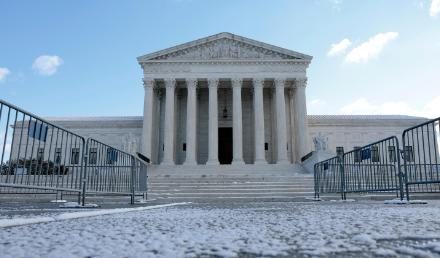
The OSHA Vaccine Mandate
The Secretary of Labor enacted a vaccine mandate covering almost all employers with at least 100 employees. It requires workers to receive a COVID-19 vaccine and preempts state laws that differ. The only exception is for those workers who obtain a medical test each week at their expense and on their own time and wear a mask at work. Employees who do not comply must be removed from the workplace and employers can face fines from $13,653 to $136,532.
Limitations on OSHA Standards
OSHA’s Scope is Limited to the Workplace. OSHA is tasked with ensuring occupational safety. Standards enacted must be reasonably necessary or appropriate to provide safe or healthful employment. Even the Solicitor General admitted that OSHA is limited to regulating dangers in the workplace.
Emergency Standards Can Be Enacted in Limited Circumstances. Most standards enacted by OSHA or other agencies must follow a rigorous process that includes a notice and comment period.
There is, however, an exception for emergency temporary standards. The process is not applicable and can take effect immediately if employees are exposed to grave danger and the emergency standard is necessary to protect employees from the danger. The OSHA COVID-19 vaccine mandate took effect as an emergency temporary standard. It also failed to make any distinctions based on industry or risk of exposure to COVID-19.
The Court Rejects the Vaccine Mandate
The Supreme Court concluded that the Occupational Health and Safety Act does not authorize this vaccine mandate. While COVID-19 may be a risk in many workplaces, COVID-19 is not an occupational hazard in most workplaces. COVID-19 spreads at home, school and public gatherings. As such the risk of COVID-19 is no different from the day-to-day dangers that face everyone in daily life. The fact that COVID-19, like the hazards of daily life, poses risks to persons at work does not authorize OSHA to exercise regulatory authority without clear congressional approval.
OSHA may, however, regulate occupation-specific risks related to COVID-19. OSHA can regulate where the virus poses a special danger because of particular features of a certain job or workplace. Examples of job duties or workplaces where regulation might be appropriate include researchers who work with the virus and crowded or cramped work environments. But an indiscriminate approach takes on the character of a general public health measure rather than an occupational standard. Compelling 84 million Americans to vaccinate simply because they work for employers with more than 100 employees is not an occupational standard.
Effect on California Employers
The obvious affect of the Court’s ruling is that employers with 100 or more employees are not compelled, by federal law imposed by OSHA, to vaccinate their employees. However, the Court’s ruling does not directly affect the orders issued by the California Department of Public Health or local Departments of Public Health. Nor does the ruling affect Cal/OSHA’s regulatory powers, which includes a new emergency temporary standard that takes effect on January 15, 2022.
Do You Need More Information?
Do you need help with managing the ever-evolving COVID-19 laws? Join us for a zoom conference on Thursday, January 27th at 9 am to discuss the Supreme Court’s ruling, and the many state orders and mandates affecting California workplaces. Register at receptionist@flclaw.net.
01.07.22
COVID-19 Update: Cal/OSHA Aligns Guidance for Isolation and Quarantine with CDPH
COVID-19
COVID-19 Update:
Cal/OSHA Aligns Guidance for Isolation and Quarantine with CDPH
The number of executive agencies, at both the state and federal level, advising on or regulating individual behavior during this pandemic, and the frequency with which those communications are issued, continues to be extremely confusing for employers. Thankfully, today it gets slightly less overwhelming as Cal/OSHA has clarified employer expectations in light of both CDC and California Dept. of Public Health (CDPH) guidance (issued December 30 and updated January 6).
Work Exclusion Requirements
We sent an update earlier this week after the CDPH’s initial guidance. That guidance has been modified slightly, and now the CDPH and Cal/OSHA seem to be on the same page. We review the Cal/OSHA and CDPH requirements below, but your local health department may have issued more strict guidance. (Please send us an e-mail if you would like a PDF document of the tables below.)
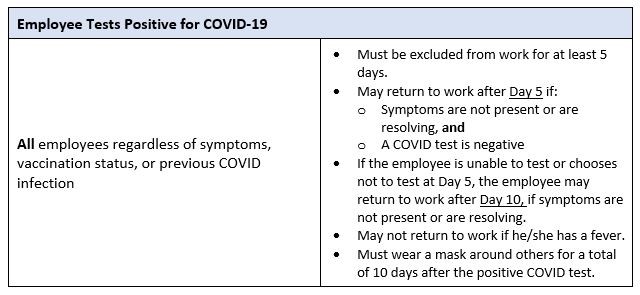
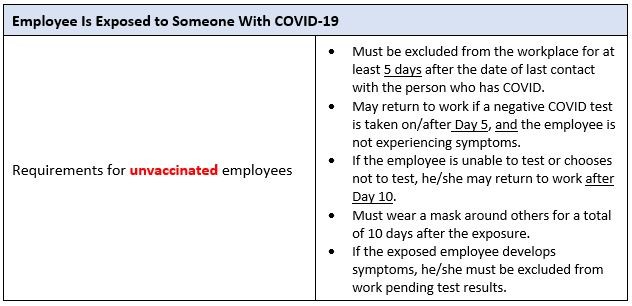
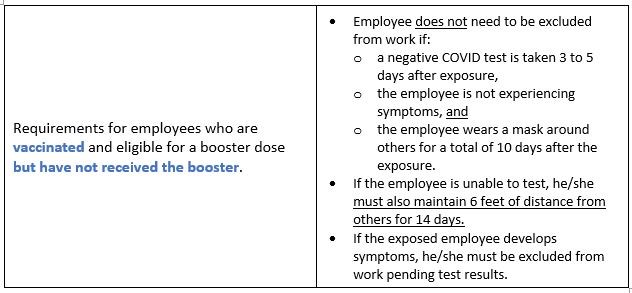

You may notice that the post-exposure exclusion requirements are virtually the same for vaccinated employees, with or without the booster dose. We’re not sure why the CDPH makes this distinction, but it may be in anticipation of future changes for either status.
Neither the CDPH nor Cal/OSHA directly address the situation of a symptomatic employee with no known COVID exposure. We recommend employers follow the guidance above for those who have tested positive, unless the employee takes a negative COVID-19 test or provides medical certification of a different illness (such as a sinus infection.) If the employee cannot or will not provide such documentation, he/she should be excluded from work for ten days from the start of symptoms.
Employees may be permitted to take rapid tests or at-home tests to satisfy the CDPH requirements. However, according to Cal/OSHA an over-the-counter test may not be both self-administered and self-read. This means the test must be observed by the employer or an authorized telehealth proctor. (If your employee is excluded from work pending a test result, you may observe the test through a video call/meeting.)
__________________________________
California Mask Mandate
A statewide mask mandate was originally set for December 15, 2021 through January 15, 2022. On January 5, the CDPH extended this mask mandate until February 15, 2022.
Employers should take this mask mandate seriously. The Dept. of Industrial Relations (DIR) updated their FAQ page after the CDPH issued the original mask mandate on December 13, 2021. The DIR reminded employers that while Cal/OSHA no longer explicitly required face coverings generally, the regulation still required employers to “ensure [face coverings] are worn by employees when required by [CDPH] orders.” The DIR added, “The [CDPH mask mandate] is such an order.”
We recommend that employers follow the CDPH mask mandate, as this mandate can be enforced by Cal/OSHA.
__________________________________
Federal Vaccine Mandate
Just this morning, January 7, 2022, the Supreme Court of the United States heard oral arguments related to the federal OSHA vaccine mandate and deliberated about whether to implement an administrative stay before the (delayed) mandate goes into effect this coming Monday, January 10, 2022.
That said, the federal mandate doesn’t impact employers in California – at least, not directly. Because California has a state plan (Cal/OSHA), federal emergency action like this vaccine mandate simply triggers a state-level response. This means that California has 30 days to discuss what the vaccine mandate will look like in our state, and these discussions will be taking place at the same time as the Supreme Court weighs whether or not the original mandate is even constitutional.
For now, there is no action required of California employers regardless of whether the Supreme Court issues a stay before the January 10 implementation deadline. We will continue watch for Cal/OSHA’s reaction to the Supreme Court’s decision and alert clients of any announced state requirements.
01.07.22
Isolation and Quarantine (“Exclusionary”) Periods For California Employees
COVID-19
Isolation and Quarantine (“Exclusionary”) Periods
For California Employees
by Doug Larsen of Fishman, Larsen, & Callister
Late on January 6, 2022, Cal/OSHA updated its FAQs on its COVID-19 Emergency Temporary Standard (“ETS”) incorporating recommendations issued by the California Department of Public Health (“CDPH”) on isolation and quarantine periods (also known as exclusionary periods). While the Cal/OSHA exclusionary periods have remained constant for the past six months, recommendations from the CDC and CDPH have changed several times. Currently, the recommendations from the CDC and CDPH are assuming that the omicron strain is less serious, and that people can return to the workplace and reintegrate into society much more quickly.
The Cal/OSHA update helps clarify the amount of time an employee must be excluded from the workplace in the event the employee has COVID-19 or has been in close contact with others with COVID-19.
History of Excluding Employees from Work
When Cal/OSHA approved the current ETS in June of 2021, it included rules requiring employers to exclude from the workplace employees with COVID-19 and persons who were exposed to COVID-19. These exclusionary periods differed from recommendations provided by the CDC and the California Department of Public Health (“CDPH”).
Accordingly, Governor Newsom issued an executive order that declared the ETS exclusionary periods are overridden by CDPH recommendations when they were longer than those recommended by the CDPH.
Last night’s announcement clarifies that employers should follow the CDPH guidelines when determining how many days an employee with COVID-19 or exposed to COVID-19 must remain away from the workplace. In fact, Cal/OSHA recommends we begin following the ETS now which does not go into effect until January 14, 2022.
Exclusion Rules Under the January 2022 ETS
Employees Who Test Positive for COVID-19. Employees who test positive must be excluded from the workplace for at least 5 days. They may return after day 5 if symptoms are not present or are resolving and a specimen collected on day 5 or later tests negative.
If an employee does not test but the employee’s symptoms are not present or are resolving, the employee may return after the 10th day of exclusion.
Any employee must continue to be excluded until any fever resolves. “Fever” means a body temperature of 100.4 degrees Fahrenheit or higher. Resolution of the fever means the body temperature is less than 100.4 degrees Fahrenheit for at least 24 hours without fever-reducing medication.
The employee must continue to avoid the workplace if symptoms are not resolving or until day 11 from a positive test. Employees who do return to the workplace must wear face coverings around others for 10 days after a positive test.
Exposed Employees Who are Unvaccinated or Did Not Receive a Booster.
Cal/OSHA and the CDPH consider a person who has been vaccinated but has not received a booster for which the person is eligible to be the same as an unvaccinated person. These persons must be excluded from the workplace for at least 5 days after the last close contact with a COVID-19 case. These persons must also test on day 5. If the test is negative and if symptoms are not present, the person can return to the workplace. An employee who does not have symptoms but who does not test must be excluded from the workplace after 10 days of exclusion.
Employees must wear face coverings around others for 10 days after close contact.If an exposed employee develops symptoms, the employee must be excluded pending the results of a test.
A person is eligible for a booster 6 months after the second dose of the Moderna or Pfizer vaccine. A person is eligible for a booster 2 months after the Johnson and Johnson vaccine.
Exposed Employees Who are Fully Vaccinated. If the employee has been vaccinated and has either received a booster or is not yet eligible for a booster may remain at work even if in close contact with a person with COVID-19. However, this person must test on day 5. The test must come back negative. This employee must also wear a face covering for 10 days after exposure. If the employee develops symptoms, the employee must be excluded pending the results of a test.
Date of COVID-19 Testing. Employees with COVID-19 must test on or after day 5 of a positive test. Employees partially or fully vaccinated must test on day 5. I’m not sure why the law makes this distinction. Cal/OSHA says that employers should follow the ETS for fully vaccinated employee who “cannot be tested on day 5.” This means that fully vaccinated employees must wear a face covering and maintain six feet of distance for 14 days following close contact.
Do You Need More Information?
Do you need help with managing the ever-evolving COVID-19 laws? Join us for a zoom conference on Thursday, January 27th at 9 am. Register at receptionist@flclaw.net.
01.05.22
COVID-19 Update: New Guidance on COVID Isolation Requirements
COVID-19
COVID-19 Update
New Guidance on COVID Isolation Requirements
 The latest installment of state and federal COVID announcements leave us with more questions than answers…. You have probably heard that the CDC recently shortened its recommended quarantine timeline for COVID-positive individuals from ten days to five. On December 30, 2021, the California Department of Public Health (CDPH) published its own update in alignment with the CDC.
Both the CDC and CDPH advise the following isolation and quarantine timeframes (included in the CDPH announcement):
Positive COVID-19 Test
- Persons who test positive for COVID-19 should isolate at home for five days, regardless of symptoms or lack thereof, vaccination status, or previous COVID infection.
- Isolation can end after five days if symptoms are resolved or resolving and a COVID test is negative.
- The individual should continue to wear a mask for an additional five days.
COVID-19 Exposure
- Individuals who have been in close contact with a COVID-19 case are not required to quarantine if they are fully-vaccinated and have received a booster dose.
- Individuals who are unvaccinated or who have not received a booster, should stay home for five days after the last contact with the COVID-positive person. If COVID symptoms do not develop and a COVID test is negative after day five, quarantine can end.
BUT WAIT!
Before you start revising your company’s COVID protocols, remember that our workplaces are still bound by the Cal/OSHA emergency temporary standard for COVID-19. In fact , the CDPH specifically states that workplaces should consult Cal/OSHA regulations for “additional requirements.”
Those requirements currently include a mandatory ten-day isolation for any employee who tests positive for COVID, and ten days of quarantine for unvaccinated employees who have been in close contact with a COVID-19 case.
Further, in its revised regulations that become effective on January 14, 2022, Cal/OSHA states that fully-vaccinated employees may stay at work following an exposure to COVID only if they 1) remain symptom-free, 2) wear a face covering for 14 days following the date of close contact, 3) maintain six feet of distance from others at the workplace for 14 days, and 4) get a COVID test three to five days after the close contact. Because of the nature of the workplace, or the nature of services provided in the workplace, maintaining the six feet of distance may be impractical or impossible. Thus, the only viable solution may be to exclude those employees from the workplace. If the exposure is work-related, employers must provide exclusionary pay for any missed work hours.
So, what do we do with this conflicting information?
The CDC and CDPH give guidance and recommendations to individuals, while Cal/OSHA gives enforceable regulations to employers. We hope that Cal/OSHA will update its standard to align with these other agencies, but until then we advise maintaining the existing ten-day timelines for excluding employees from work.
Stay Tuned
Sierra HR Partners will provide more details regarding the Cal/OSHA updates that become effective on January 14, and there will be an upcoming Legal Beagle Bagel Breakfast training opportunity with Doug Larsen on all of the recent changes.
As always, Sierra HR Partners is here to help you navigate the ever-changing landscape of COVID-19 precautions. Stay tuned for more information, and contact one of our Consultants with any questions you have.
