
Employee Engagement
Announcements
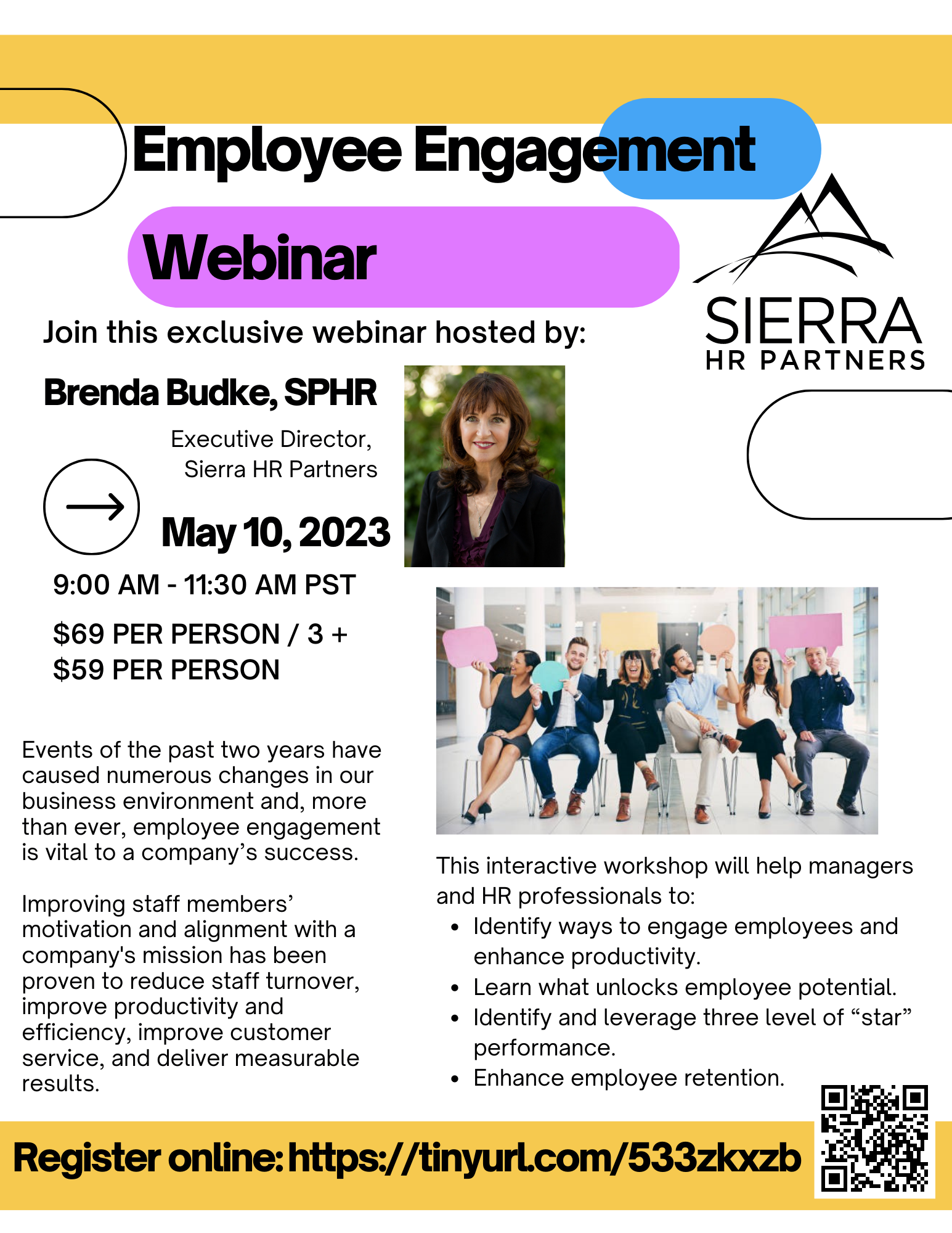
Register online: https://tinyurl.com/533zkxzb
Register online: https://tinyurl.com/533zkxzb
 On March 3, the California Department of Public Health (CDPH) announced new COVID-19 guidelines that will go into effect on Monday, March 13, 2023. These new guidelines will replace current guidelines.
Sierra HR Partners has developed an updated document summarizing the new information below. Please e-mail us to request a PDF copy.
A New Exclusion Approach
If an employee reports testing positive for COVID-19, they must be directed to stay home. Under the previous guidance, they could return to work five days after the start of their symptoms if they tested negative at that point. Without a negative test, they’d be excluded from work until after Day 10. Under the new guidance, individuals may return after Day 5 simply if they feel well. Like before, it’s still critical that symptoms have improved and that the employee has been fever-free for at least 24 hours, but a negative test will no longer be required.
Mask Guidance
Under previous guidance, those who returned to work after 5 days were still required to wear a mask through Day 10. Under new guidance, those who return after 5 days may remove their masks sooner, if two sequential negative tests are taken at least a day apart. The employee may stop wearing a mask after Day 10 without a negative test.
COVID Exposure
The CDPH recommendations for people with symptoms or who were exposed to a COVID-19 case are unchanged. If you have COVID-19 symptoms, the CDPH recommends that you isolate and test as soon as possible. If you are exposed to someone with COVID-19, you do not need to isolate, but the CDPH recommends that you test 3-5 days after exposure and wear a mask for 10 days after exposure.
These changes to our COIVD response are in addition to other recent changes, including to the definition of “close contact” and the removal of “exclusion pay” related to workplace COVID exposures. You can read about those changes in our COVID-19 Update Headliner from early February.
What About Healthcare?
The guidelines discussed above are for non-healthcare settings. The CDPH continues to maintain separate guidance for healthcare facilities.
That said, the end of the state of emergency in California on February 28 has allowed guidance for healthcare and other high-risk settings to change. Under this new guidance, effective April 3, masks are no longer required in healthcare and high-risk settings. The CDPH adds, “Health care facilities and other high-risk setting operators should develop and implement their own facility-specific plans based on their community, patient population, and other facility considerations incorporating CDPH and CDC recommendations” (emphasis added). Additionally, effective April 3, vaccines are no longer required for healthcare workers.
 The phrase “Time is Money” is perhaps never more true than when we’re navigating California wage and hour law. A 2021 court ruling regarding the calculation of rest and meal period premiums may have created an important and challenging new step in your payroll process.
As you know, California Labor Code section 510 and IWC Wage Orders require that employees receive overtime compensation at 1.5 times their regular rate of pay for work hours over 8 in a workday or over 40 in a workweek. If an employee receives multiple pay rates in a workweek (for example, a shift differential for certain shifts), or earns commissions or non-discretionary bonuses, the regular rate of pay must be calculated using these amounts.
California Labor Code section 226.7 states that if an employee is not provided with a rest or meal period in accordance with the law, “the employer shall pay the employee one additional hour of pay at the employee’s regular rate of compensation.” Unlike regular rate of pay, the Labor Code and Wage Orders do not define this term, and employers have historically interpreted the requirement as one additional hour at an employee’s straight-time hourly rate.
A 2015 class action lawsuit, Ferra v. Loews Hollywood Hotel, LLC, challenged this practice. The complainant argued that non-discretionary incentive payments should be included in the regular rate of compensation when calculating rest and meal period premiums. The trial court found in favor of the defendant, saying that the terminology used in the two Labor Code sections were not interchangeable, and the calculations involved in regular rate of pay were not applicable to rest and meal period premiums. In 2019, a Court of Appeals affirmed the trial court’s decision and employers breathed a huge sigh of relief….
….Until July 2021, when the California Supreme Court reversed both the trial court’s and the Court of Appeals’ findings. In its decision, the Supreme Court acknowledged that we are not given a clear definition of the term regular rate of compensation, but held that this does not mean the drafters of the law intended for there to be a different approach. In fact, the Court determined that the terms had been used interchangeably in legislative sessions and court decisions.
Based on this ruling, rest and meal period premiums must be calculated using either a weighted average of the employee’s pay rates and earnings in a workweek, or including non-discretionary incentives received during the workweek. The Court also stated that the ruling would be applied retroactively saying, “no considerations of fairness or public policy” warranted applying the policy only for future practices. (If an employee earns just one hourly rate and no commissions or bonuses, the regular rate of pay is simply the straight-time hourly rate.)
We know that calculating an employee’s regular rate of pay can be extremely confusing. Please contact one of our certified Consultants if you have questions about your current payroll procedures.
After almost three years of being in an “emergency” state, Cal/OSHA has finally published its non-emergency COVID-19 standard.
Last month, Cal/OSHA submitted its non-emergency COVID regulation to the state for final approval. The state Office of Administrative Law (OAL) approved the regulations Friday afternoon, February 3, 2023. These non-emergency regulations will remain in effect for two years (or, in the case of recordkeeping requirements, three years).
What are the most important elements of this non-emergency standard that employers should be aware of?
What Has Not Changed
Employers must maintain a plan to address COVID-19. While you are no longer required to maintain a separate COVID-19 Prevention Program, you must still address COVID-19 hazards as part of your Injury & Illness Prevention Plan (IIPP.) This means that, as with other hazards, you will need to account for employee training and compliance and hazard assessment, correction, and prevention.
You may continue to maintain a separate program if you prefer. Whether as a separate program or part of their IIPP, employers must:
What Has Changed
Many of the burdensome requirements of the emergency standard have been eliminated from the permanent standard (whew!):
Not all the administrative burdens have been removed, though. Major outbreaks – when there are 20+ COVID-19 cases within a 30-day period – must be reported to Cal/OSHA, and employers must notify employees “as soon as possible” of close contact with COVID-19 cases. Also, new legislation effective January 1, 2023 specifies that employers must post written notice about workplace COVID cases for at least 15 days.
The definition of “close contact’ has also changed. Only in indoor spaces of over 400,000 cubic feet does the familiar definition apply (being within 6 feet for a cumulative 15 minutes over 24 hours). For smaller spaces, close contact happens when individuals share the same indoor airspace for a cumulative 15 minutes or more over 24 hours. “Airspace” has not been defined, but the CDPH provided, as examples, “home, clinic waiting room, airplane.”
Other Resources
Cal/OSHA has provided a courtesy copy of the final text of the non-emergency regulation, with changes stricken. They have also provided a two-page document summarizing some of these changes.
The “exclusion pay” requirement is almost behind us – but not quite. 
“Exclusion pay” refers to the requirement that an employer maintain “an employee’s earnings, wages, seniority, and all other employee rights and benefits” if the employee is excluded from work for work-related COVID exposure. This benefit was part of part of the original COVID-19 emergency standard, first passed by Cal/OSHA at the end of 2020.
Normally, an emergency temporary standard passed by Cal/OSHA has a short shelf-life. This is by design, encouraging rule makers to follow the strict administrative process for passing regulations. As you know, the COVID-19 standard was extended multiple times, and a December 2021 executive order allowed this emergency standard to continue through the end of 2022.
As the emergency standard expiration deadline loomed, the Cal/OSHA Standards Board was divided by the issue of exclusion pay, with labor advocates pushing for its inclusion in the new non-emergency standard (“non-emergency” because most requirements expire after two years). However, Cal/OSHA ultimately removed it from the standard that they adopted on December 15, 2022.
But don’t be too hasty. The standard does not go into effect until approved by the Office of Administrative Law, and OAL rules dictate that when a regulation is adopted and sent for review, the emergency regulation remains in effect during OAL’s review, up to 30 working days. This means that the emergency COVID-19 standard – technically set to expire last week on December 31 – could potentially extend into February. It remains active today.
The OAL could grant approval of the non-emergency standard sooner than that, of course. For now, though, employers should continue to provide exclusion pay. Sierra HR will update clients as soon as we know an official exclusion pay end date.
You can find the non-emergency COVID standard here.
As always, Sierra HR Partners is here to help you navigate the ever-changing landscape of COVID-19 precautions and paid leave benefits. Please contact one of our Consultants with any questions you have.